Reactive Glaze
Reactive Glaze – When Every Product Gets Its Own Expression
A reactive glaze gives each product a vibrant and unique expression. That is exactly what makes it so special. In ceramics, glaze is used for both aesthetic and functional reasons – it gives the surface its color and character while also sealing the material and making it water-resistant.
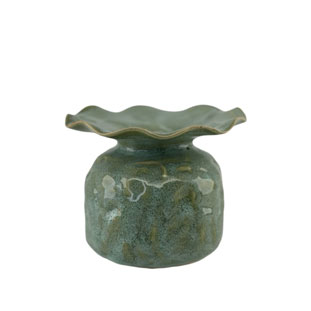
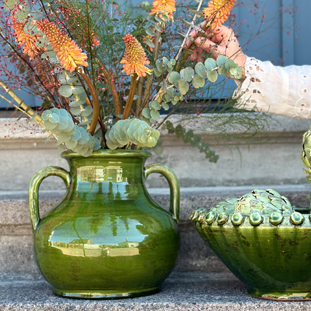
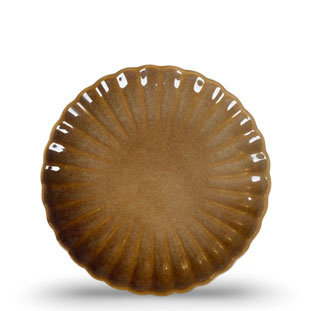
A reactive glaze, however, takes this a step further. Color variations, depth, and movement emerge in the surface – small pores and speckles may appear – and these variations cannot be reproduced exactly. Each piece becomes its own small original.
These variations are a natural part of the manufacturing process and contribute to the vibrant and unique expression that we at Miljögården strive for and appreciate.
How does the firing process work for reactive glaze?
When a product is fired in the kiln, often at temperatures around 1,250°C, the different components of the glaze begin to melt and react with one another. In a reactive glaze, the mixture contains minerals and oxides that respond differently to the heat. This is where the magic happens.
The heat, the supply of oxygen, how the glaze has been applied, and how the piece itself is shaped all influence the final result. Colors may flow into one another, creating speckles, variations, and depth. Sometimes the surface becomes soft and hazy; other times it appears more defined and full of contrast. It is a chemical reaction that can never be completely predictable – and that is exactly what makes it so beautiful.
That is why no two products ever look exactly the same.
The differences may be subtle:
-
a slightly darker tone
-
a more defined edge
-
a softer play of color
-
a more vivid pattern
…or more pronounced, where the colors almost seem to move across the surface like a landscape.
For us, this is not a deviation – it is the very point. These variations show that the product has gone through a genuine craft process. It is not mechanically mass-produced, but created through the interaction of material, human hands, and fire.
When working with reactive glaze, each product should therefore be seen as its own small work of art. The pieces belong together through their color palette and overall feeling, yet each one has its own personality.